Paper Cups vs Plastic Cups: Which Packaging Solution Is Better?
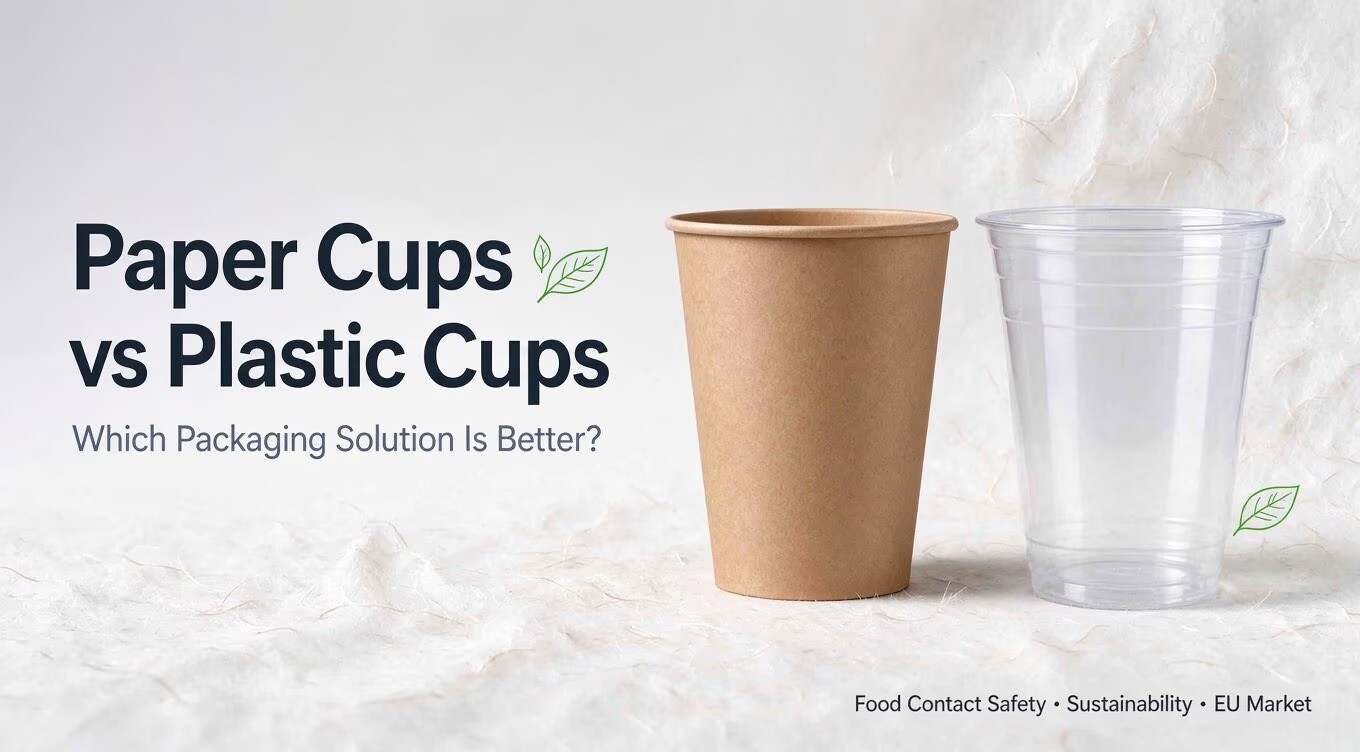
As food brands, coffee chains and catering operators across Europe face growing pressure on sustainability, the long-running debate between paper cups and plastic cups has moved from the marketing page into real purchasing decisions. There is no universal winner — but for most foodservice businesses, the answer is becoming clearer.
1. Setting the scene: why the debate matters now
The question of paper versus plastic is not new. For decades, foodservice operators chose packaging almost purely on price, availability and function. But the landscape has changed. Consumers now read labels, inspect packaging and ask whether a brand's cups can be recycled or composted. Regulators in Europe, led by markets such as Germany and France, have tightened packaging legislation, extended producer responsibility (EPR) schemes, and pushed for fibre-based alternatives in single-use food packaging. At the same time, the cost of compliance — of documentation, testing and traceability — has become a genuine factor in every purchasing decision.
This is why "paper or plastic" is no longer a simple either/or. It is a strategic decision that touches branding, cost, food safety, regulatory readiness and the story a company tells its customers. Understanding the trade-offs is essential before placing a single order.
2. The sustainability question
Plastic cups are lightweight, cheap and highly durable. A PET or PP cup can be reused many times, which on the surface looks efficient. Yet their end-of-life story is where the problems begin. Only a small fraction of plastic packaging is effectively recycled, and much of the rest ends up in landfills or the ocean, where it can take centuries to degrade into microplastics. Even where collection systems exist, the quality of recycled plastic often limits how many times it can be reused, so "recyclable" does not always mean "recycled in practice".
Paper cups, by contrast, are made from renewable, plant-based fibre. When properly coated and disposed of correctly, they can be recycled or composted. In markets such as Germany, where packaging legislation and EPR frameworks are strict and tightening further, brands are actively seeking fibre-based alternatives that align with both compliance and consumer expectations. For takeaway coffee, delivery food and event catering, fibre packaging carries a visible environmental signal that resonates with today's customers.
That said, it would be misleading to claim paper is automatically the greener option. A paper cup requires more energy and water in production than a lightweight plastic cup, and the plastic or bio-based lining affects its recyclability. The real difference lies in responsible sourcing — FSC-certified paper, water-based or PLA coatings — and in the disposal behaviour of the end user. The sustainable choice is not the material alone; it is the whole system around it: how the paper is grown, how the cup is made, how it is used and how it is discarded.

3. Performance and food contact safety
For hot drinks and hot food, paper cups with a food-grade lining have clear practical advantages. They insulate better, remain comfortable to hold even when filled with hot content, and can be printed with high-quality branding that strengthens a takeaway or delivery offer. For single-use formats such as takeaway coffee or Korean-style delivery containers — gimbap, bibimbap, fried chicken, salad, soup and rice — paper-based solutions are trusted by operators who value both presentation and food safety.
Food contact compliance is where experience matters most. Paper cups intended for the EU market must meet the requirements of Regulation (EC) No 1935/2004 and Commission Regulation (EU) No 10/2011, supported by migration test reports, a Declaration of Compliance (DoC) and Good Manufacturing Practice (GMP) confirmation. In practice, this means a responsible buyer should request a full documentation package before ordering:
- EU Declaration of Compliance (DoC) confirming compliance with the applicable food-contact regulations;
- Food contact test reports;
- Full migration test reports, including overall migration (OML) and specific migration (SML) tests;
- Reports that identify the exact product model, material, test methods, food simulants, time and temperature conditions, and results;
- Material composition details for the container body, lid, seals, colorants and additives;
- Confirmation of compliance with the Good Manufacturing Practice Regulation (EC) No 2023/2006;
- A written statement of the permitted conditions of use — food types, maximum temperature, microwave and freezer suitability;
- Product identification and batch traceability information;
- Testing laboratory details, including accreditation status where applicable.
Beyond the EU baseline, buyers targeting the German market in particular often ask for LFGB certification, REACH SVHC testing, PFAS and heavy-metal reports, and a Safety Data Sheet (SDS). A manufacturer that can produce these documents reliably — and match them to the exact product being supplied — saves the buyer time, reduces legal risk and protects their ability to sell in the market.
Plastic cups still lead on clarity, flexibility and cost in certain segments, such as cold drinks and large-volume events, where a transparent, shatter-resistant cup is preferred. They are also more forgiving in handling and require less rigorous temperature control. For these applications, high-quality, food-safe plastic remains a legitimate, cost-effective option, provided it is sourced from suppliers who can demonstrate compliance just as rigorously as paper producers must.
4. Cost and supply-chain reality
Cost comparisons are rarely as simple as they appear. A plastic cup may be cheaper per unit, but the full picture includes recycling fees, EPR obligations, and the risk of regulatory penalties or lost customers if a brand is perceived as environmentally unfriendly. Paper cups, while often more expensive per unit, can carry higher perceived value and enable brands to charge a premium aligned with their sustainability positioning.
Supply-chain reliability also matters. Paper cups are more sensitive to storage conditions than plastic, and the quality of the coating and printing depends on consistent manufacturing processes. Buyers should look for manufacturers with direct production experience, stable lead times and the ability to confirm mould availability, MOQ and sample lead times up front.

5. What buyers should weigh
Instead of asking which material is "better", buyers are better served by matching the packaging to the application:
- Hot takeaway and food delivery — fibre-based cups and containers offer insulation, a premium print surface and a sustainability story customers respond to.
- Cold drinks and high-volume events — clear, durable plastic remains practical and economical.
- Regulated markets such as Germany — verify every document: DoC, migration reports, REACH SVHC, PFAS and heavy-metal tests, and full batch traceability.
- Branding and differentiation — if the packaging is part of the product experience, the print quality, texture and finish of the paper cup often outweigh the unit-cost difference.
6. The practical conclusion
There is no single right answer. The best packaging solution is the one that fits the product, the market and the regulatory environment — delivered by a manufacturer that can prove compliance, not just claim it. As European regulation continues to shift toward fibre-based single-use packaging, paper cups offer brands a forward-looking path that combines functionality, food safety and environmental responsibility.
At Judin Pack, we specialise in food-grade paper cups, containers and delivery packaging for EU markets, supported by the full documentation package our customers require to sell with confidence. Whether you need insulated hot cups, moisture-resistant linings, custom-branded designs or verified food-contact documentation, our team is ready to support your next project.
Overcoming Delivery Damage with Double Wall Trays and PET Lids for Food
Related Article


